
Can AI Replace Humans at Work? The Future and Limitations of Artificial Intelligence in the Next 10 Years (2026–2036)
Discover whether AI will replace human jobs by 2036. Explore future careers, jobs at risk, AI limitations, emerging opportunities and the skills humans need.
Introduction: Will Artificial Intelligence Replace Human Workers?
Artificial Intelligence (AI) is transforming the modern workplace. From content writing and software development to healthcare, education, manufacturing and digital marketing, AI is changing how people work and how businesses operate.
Today, artificial intelligence can write articles, generate images, analyse information, create computer code, answer customer questions and automate repetitive business activities. These developments have created an important question: Will AI replace human workers in the next 10 years, or will humans and artificial intelligence work together?
Between 2026 and 2036, AI is expected to transform many industries. Some traditional jobs may disappear, others may change, and new career opportunities may emerge. However, artificial intelligence still has limitations involving human emotions, practical experience, critical thinking, creativity and real-world decision-making.
The future may not belong to people who compete against AI. It may belong to people who understand how to use AI effectively.
1. How AI Is Changing the Workplace in 2026
Artificial intelligence is no longer limited to large technology companies. Small businesses, freelancers, startups and multinational organisations are adopting AI-powered tools to improve productivity and reduce repetitive work.
Some important applications of AI include:
- Content Creation: Writing articles, blogs, advertisements and social media content.
- Customer Support: Answering customer questions through intelligent chatbots.
- Software Development: Generating code, identifying errors and assisting developers.
- Graphic Design: Creating marketing images, illustrations and digital designs.
- Data Analysis: Processing large amounts of information and identifying patterns.
- Healthcare: Supporting medical research and analysing diagnostic information.
- Education: Providing personalised learning assistance and educational resources.
- Business Management: Automating reports, administrative activities and workflows.
Although AI can perform many tasks faster than humans, businesses still need employees for supervision, decision-making, communication and responsibilities that require human judgement.
2. Which Human Jobs Could AI Replace in the Next 10 Years?
Jobs involving repetitive activities, predictable processes and standardised digital information are more exposed to artificial intelligence and automation.
Some occupations that could experience significant changes between 2026 and 2036 include:
- Data entry operators.
- Basic customer support representatives.
- Transcription workers.
- Basic content writers.
- Routine bookkeeping professionals.
- Simple graphic design workers.
- Administrative assistants.
- Basic translation professionals.
- Repetitive software testing workers.
- Routine document processing employees.
However, this does not mean that all these professions will disappear. AI may automate certain responsibilities while employees continue performing more complex activities that require experience, judgement and communication.
For example, AI can prepare a financial report, but a human accountant may still need to verify the information, interpret regulations and provide professional advice.
3. Which Jobs Will Be Difficult for AI to Replace?
Not every profession can be automated easily. Many occupations require practical experience, physical skills, emotional intelligence, human relationships and responsibility.
Healthcare Professionals
Doctors, nurses and surgeons need to examine patients, understand complex situations and make important treatment decisions. AI can assist medical professionals, but human judgement and patient care remain essential.
Teachers and Educators
AI can prepare lessons and explain educational subjects. However, teachers also motivate students, understand individual learning difficulties and develop social skills.
Electricians and Plumbers
Installing electrical systems, repairing equipment and solving unexpected problems require practical experience and physical skills.
Construction Workers
Construction activities involve changing site conditions, physical coordination, safety decisions and real-world problem-solving.
Business Owners and Entrepreneurs
Starting and managing a business requires leadership, customer understanding, financial decisions, negotiation and the ability to take responsibility for business risks.
Psychologists and Counsellors
AI can provide general information and supportive conversations, but professional counselling requires human understanding, clinical judgement and responsibility.
4. What New Jobs Will AI Create by 2036?
Every major technological revolution has created new employment opportunities. The internet created careers in web development, digital marketing, cybersecurity and e-commerce. Artificial intelligence is also expected to create new professional opportunities.
Some emerging career opportunities include:
- AI engineers and machine learning specialists.
- AI automation consultants.
- AI application developers.
- Robotics engineers.
- AI security specialists.
- AI ethics and governance professionals.
- Data analysts and data scientists.
- AI-powered digital marketing specialists.
- AI business consultants.
- Robotics maintenance technicians.
- AI education and training specialists.
- AI product managers.
Entrepreneurs may also find opportunities to develop AI-powered services, digital products and online businesses.
According to the World Economic Forum's Future of Jobs Report 2025, employers project that 170 million jobs could be created and 92 million displaced globally by 2030, resulting in a net increase of 78 million jobs. These projections reflect several economic and technological changes, not artificial intelligence alone.
5. The Biggest Limitations of AI: Why Humans Will Still Matter
Artificial intelligence is powerful, but it is not perfect. Understanding its limitations is important when discussing the future of human employment.
A. AI Does Not Experience Human Emotions
AI can recognise emotional language and generate empathetic responses, but this does not mean it experiences emotions like a human. Human relationships involve personal experiences, empathy, trust and emotional understanding.
B. AI Can Make Mistakes
AI sometimes produces incorrect information, misleading explanations and inaccurate calculations. Even when an answer sounds convincing, it may not be correct. Human verification is important, especially in healthcare, finance, law and business.
C. AI Has Limited Real-World Understanding
AI can explain how to repair a machine, but physically diagnosing an unusual mechanical problem in a difficult environment requires practical experience. Robotics may improve, but real-world situations remain complicated.
D. AI Depends on Data and Technology
AI systems depend on data, computing infrastructure, software and reliable technology. Incorrect, incomplete or biased data can produce poor results.
E. AI Cannot Take Every Human Responsibility
Important decisions involving law, medicine, public safety, finance and human rights require accountability. AI can provide recommendations, but people and organisations must establish responsibility for important decisions.
F. AI Creates Privacy and Security Risks
Artificial intelligence introduces risks involving personal information, confidential business data, cyberattacks, misinformation and data misuse. Businesses need appropriate security policies and human supervision.
G. Human Creativity Is More Than Generating Content
AI can generate music, artwork, articles and designs. However, human creativity also involves personal experience, cultural understanding, original intentions and emotional expression.
6. How Will AI Transform Different Industries Between 2026 and 2036?
Artificial intelligence could significantly change how different industries operate during the next decade.
- Healthcare: AI-assisted diagnosis, medical research and patient monitoring.
- Education: Personalised learning and AI teaching assistants.
- Banking: Automated services, fraud detection and financial analysis.
- Manufacturing: Smart factories and industrial robotics.
- Agriculture: Precision farming and automated crop monitoring.
- Transportation: Autonomous driving and intelligent logistics.
- Retail: AI-powered shopping and inventory management.
- Construction: Smart planning, robotics and safety monitoring.
- Marketing: Automated campaigns and personalised advertising.
- Real Estate: Property analysis and automated customer management.
The biggest change may not be the replacement of entire industries. Instead, businesses may redesign their operations around employees supported by AI technologies.
7. What Will the Workplace Look Like in 2036?
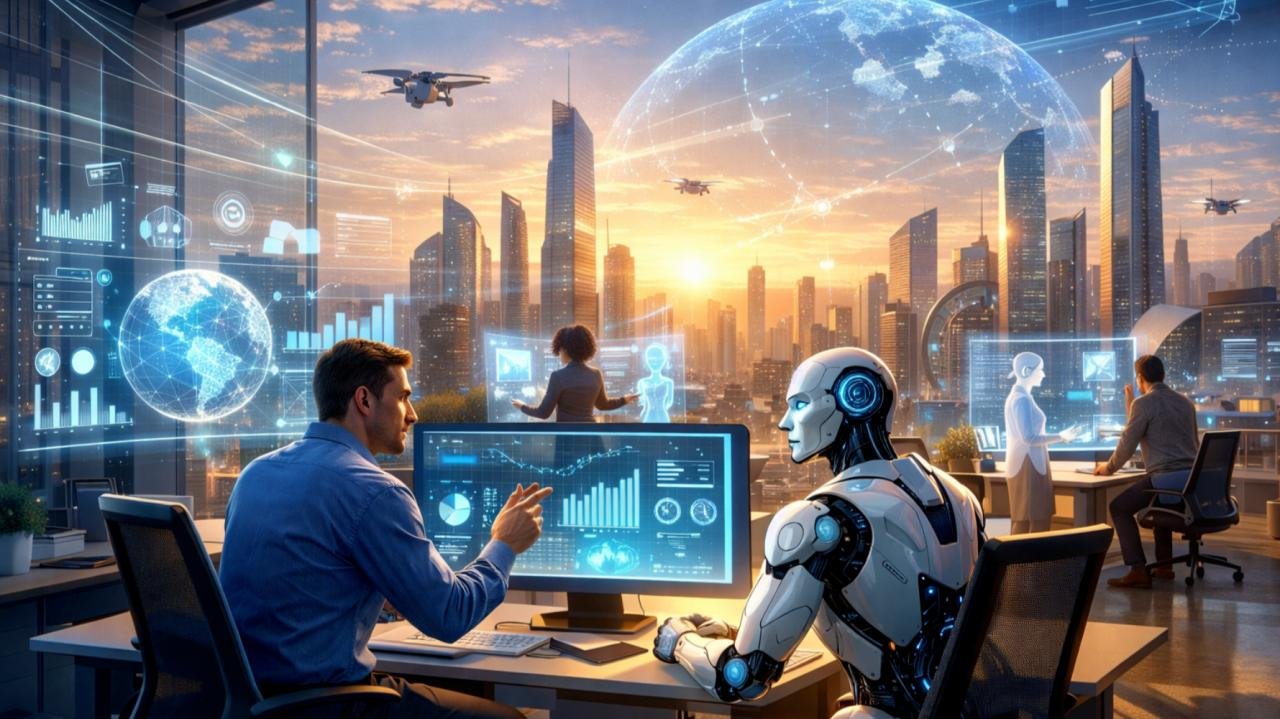
Imagine entering an office in 2036. An AI assistant may prepare your daily schedule, analyse business performance, draft reports, organise customer enquiries and suggest improvements.
A marketing professional may use AI to research customers, prepare campaigns and analyse results. A software developer may work with AI coding assistants to build applications faster. A doctor may use AI to analyse medical information while personally examining and advising patients.
Business owners may manage more operations through automation and spend less time on repetitive administrative activities.
However, this transition may not benefit everyone equally. Some workers may experience job displacement, reduced demand for certain skills or difficulties adapting to new technologies.
8. What Skills Should Humans Learn to Succeed in the AI Era?
The important question is not simply whether AI will replace humans. It is whether people will develop the skills needed to work successfully alongside artificial intelligence.
Some valuable skills for the next decade include:
- AI Literacy: Understand how AI tools work and how to use them effectively.
- Critical Thinking: Evaluate information rather than accepting every AI-generated answer.
- Communication: Develop strong speaking, writing and interpersonal skills.
- Problem-Solving: Learn to handle situations that do not have straightforward solutions.
- Creativity: Develop original ideas, products and business strategies.
- Digital Marketing: Understand SEO, advertising, social media and online customer acquisition.
- Technical Knowledge: Learn programming, data analysis, automation or relevant technologies.
- Leadership: Develop the ability to guide people and manage organisations.
- Adaptability: Be willing to learn new skills as industries change.
- Relationship Management: Build trust, negotiate and understand customer requirements.
You do not necessarily need to become an AI engineer to benefit from artificial intelligence. A teacher can use AI to improve lesson preparation, a shop owner can use it for marketing, and a freelancer can use it to increase productivity.
9. Will AI Replace Small Businesses and Entrepreneurs?
Artificial intelligence may create significant opportunities for small businesses and independent entrepreneurs.
In the past, starting a business often required hiring writers, designers, programmers, marketing professionals and administrative employees. Today, AI tools can assist with many of these activities.
Entrepreneurs can use AI to:
- Research business opportunities.
- Create website content.
- Prepare product descriptions.
- Generate advertising ideas.
- Write SEO-friendly blog articles.
- Analyse customer feedback.
- Automate repetitive business activities.
- Develop marketing strategies.
- Prepare business presentations.
However, AI cannot guarantee business success. Entrepreneurs still need to understand customers, provide quality products, build trust, manage finances and deliver reliable services.
10. Will AI Increase Unemployment Between 2026 and 2036?
Unemployment is one of the biggest concerns surrounding artificial intelligence. Some businesses may reduce hiring when AI can perform certain tasks at a lower cost. Routine office work, basic content production and repetitive administrative activities may experience particular pressure.
At the same time, businesses may expand into new areas, create new products and require different types of employees.
The overall employment impact will depend on several factors:
- How quickly companies adopt AI.
- Whether new industries create enough employment opportunities.
- How governments manage technological transitions.
- Whether workers receive adequate training.
- How affordable and reliable AI becomes.
- Whether businesses use AI to replace workers or improve productivity.
Therefore, it would be misleading to claim that AI will eliminate all human employment or that it will create unlimited jobs. The more realistic expectation is a significant transformation of the global employment market.
11. Can Humans and AI Work Together Better Than Humans Alone?
In many situations, combining human intelligence with AI capabilities can produce better results than relying exclusively on either one.
- Medical Care: AI analyses medical information while healthcare professionals provide clinical judgement and patient care.
- Business: AI analyses market data while business leaders develop strategies and manage operations.
- Education: AI prepares learning materials while teachers provide motivation and personal guidance.
- Marketing: AI generates campaign ideas while marketers develop brand strategies and customer relationships.
- Software: AI assists with coding while developers manage architecture, testing and accountability.
- Construction: AI assists with design and planning while skilled workers handle practical execution and safety.
The strongest approach is to use AI for speed, information processing and repetitive activities while humans provide judgement, responsibility, creativity and real-world understanding.
12. The Future of AI: What Could Happen by 2036?
The next ten years could bring major technological developments. The following timeline represents possible scenarios rather than guaranteed predictions.
2026–2028: AI Becomes a Normal Workplace Tool
More companies may integrate AI into customer support, office software, marketing, programming and business administration.
2028–2030: More Intelligent Automation
AI agents and robotics may become increasingly capable of handling multi-step business processes with less direct human intervention.
2030–2033: Major Changes in Professional Skills
Many employees may need to combine traditional professional knowledge with AI tools and digital capabilities.
2033–2036: Greater Human-AI Collaboration
AI could become deeply integrated into healthcare, education, transportation, manufacturing and everyday business operations.
The speed and scale of these developments will depend on technical progress, costs, regulations, public acceptance and economic conditions.
13. Who Will Succeed in the Future: Humans or AI?
The answer is not necessarily one or the other. People who refuse to adapt to changing technology may face increasing difficulties in some professions. On the other hand, people who learn new skills, develop practical expertise and use AI effectively may discover new opportunities.
Consider two professionals. The first continues using only traditional working methods and avoids learning new technology. The second develops the same professional expertise but also learns how to use AI to improve productivity.
The second professional may have a competitive advantage because they can combine human experience with technological capabilities.
This does not mean every job will be safe simply because someone uses AI. Human expertise, quality of work and the ability to adapt will remain important.
Conclusion: AI May Replace Certain Jobs, but Humans Will Remain Important
Artificial intelligence will undoubtedly change the way people work over the next decade. Some jobs will disappear, some will evolve, and new professions will emerge. Businesses will automate repetitive activities, improve productivity and discover new ways to serve customers.
However, AI still has important limitations. Human judgement, accountability, empathy, practical experience, leadership and complex real-world problem-solving remain essential in many professions.
The future should not be viewed as a battle between humans and machines. Instead, it should be viewed as an opportunity to build a world where technology supports human progress.
The biggest risk may not be that AI replaces every human worker. It may be that people who learn to use AI become more competitive than those who refuse to adapt.
The message for students, employees, business owners and entrepreneurs is simple: Do not fear AI. Understand it, learn it and use it to build a better future.
Frequently Asked Questions (FAQs)
1. Will AI replace human jobs by 2036?
AI is likely to automate certain tasks and reduce demand for some occupations. However, many jobs will change rather than disappear completely. New employment opportunities are also expected to emerge.
2. Which jobs are most at risk from AI?
Data entry, routine administration, basic customer support, transcription, repetitive content production and standardised document processing are among the areas with significant automation potential.
3. Can AI replace doctors and teachers?
AI can assist doctors and teachers with research, analysis, preparation and administrative activities. However, human judgement, patient care, teaching relationships and accountability remain important.
4. Will AI create new jobs?
Yes. AI-related opportunities are expected in engineering, cybersecurity, robotics, automation, data science, AI governance and other emerging professional fields.
5. What skills should students learn for the AI future?
Students should develop AI literacy, communication, critical thinking, creativity, problem-solving, technical knowledge and adaptability.
6. Can AI become smarter than humans?
AI may outperform humans in an increasing number of specialised tasks. However, broad human abilities, real-world understanding and general intelligence involve much more than performing individual tasks. The long-term outcome remains uncertain.
7. Will AI replace small businesses?
AI may help small businesses operate more efficiently, but business success still requires customer trust, product quality, management, financial planning and human decision-making.
8. Is learning AI necessary for future careers?
Understanding AI tools is likely to become increasingly useful across many industries. Workers do not all need to become AI developers, but learning how to use AI responsibly can improve their professional opportunities.